Smoke, Fire, and Airflow: Bringing True Southern BBQ Style to Toronto Events
Introduction
Ask most people what barbecue is, and they will describe grilled meat under a coat of sticky sauce. That is the version most commercial catering serves: standard proteins cooked on a gas grill or in a warming oven, brushed with something from a bottle, and called BBQ. It is, however, not what the tradition means.
We know the difference because we have spent nearly three decades living it. BBQ Feast is a family business that has specialized in authentic Southern-style BBQ since 1998, operating from our farm in Lakeside, Ontario. What started as a passion for real Southern barbecue has grown into one of the region’s most experienced BBQ catering operations, serving everything from intimate backyard gatherings to corporate events for thousands of guests across the GTA. The cooking process we use today is the product of decades of refinement, and it is built around three things that define true Southern BBQ: low-and-slow smoking, real hardwood smoke, and live fire.
Delivering that style at scale for corporate functions, weddings, and festivals across the Greater Toronto Area is a different job than backyard cooking. It takes serious smoking infrastructure, careful food-safety management, and a crew that can bring the whole operation to your venue. This article covers how we do it.
Key Takeaways
- True Southern BBQ style is defined by low-and-slow smoking, hardwood smoke, and live fire.
- BBQ Feast is a family business that has specialized in authentic Southern BBQ since 1998, operating from our farm in Lakeside, Ontario.
- We cater events of every size, from intimate gatherings to corporate BBQs serving thousands of guests across the GTA.
- Our hybrid process combines overnight smoking in commercial smokers with on-site finishing over live charcoal, delivering consistency at scale plus the authentic live-fire experience.
- We own and transport virtually everything an event needs: charcoal pits, rotisseries, generators, refrigeration, handwashing stations, water systems, tenting, and buffet equipment.
Logistics, Safety, and Volume Dynamics
Cooking BBQ for a 400-person wedding is a fundamentally different exercise than cooking for a family of four. Every variable a home cook can manage on the fly, from holding temperature to moisture to timing, has to be planned before the food ever leaves our farm.
The core food-safety requirement in Ontario is spelled out in Ontario Regulation 493/17 (Food Premises), which mandates that hot-held food must remain at or above 60°C until it is served. Fall below that threshold and food enters the temperature danger zone. At a large corporate event with staggered service across multiple hours, this is one of the highest-risk moments in catering, and managing it well is non-negotiable.
BBQ Feast handles hot-holding through insulated thermal cabinets rather than heated warming units. Once brisket, pork shoulder, or ribs come off the smoker, they rest in these cabinets well above the regulatory floor. That resting time does something a warming oven cannot: the meat continues to tenderize gently in its own heat, so it arrives at your event juicier and more tender than when it came off the smoker. It is the same principle a Southern pitmaster uses in the smokehouse, applied at catering volume.
Evolution and Philosophy of the Southern BBQ Style
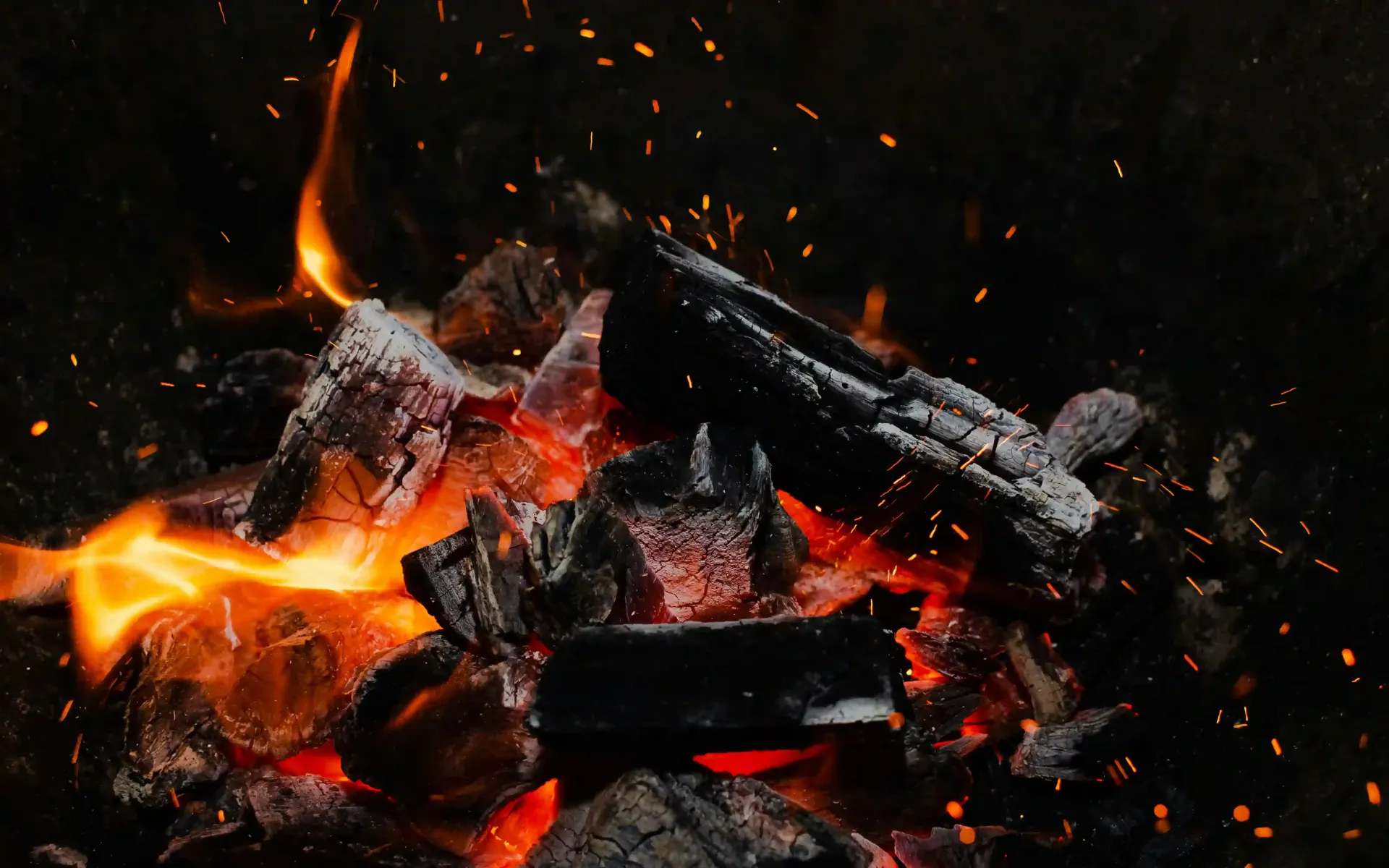
Southern barbecue evolved as a way of cooking whole hogs, brisket, and shoulders over hardwood fires for as long as it took to turn tough cuts into something a community could gather around. The tradition rests on a few fundamentals: hardwood as fuel, a clean-burning fire, and enough time for the meat to become tender. On a traditional offset pit, this is managed by hand. Modern high-volume catering has to reproduce those same conditions consistently, for hundreds or thousands of servings at a time.
That is a genuinely hard problem, and it is where much of the catering industry settles for shortcuts: pre-cooked proteins reheated in warming ovens, with sauce doing the heavy lifting. The results are familiar to anyone who has been to enough corporate lunches. Our approach is different, and it took us decades to refine.
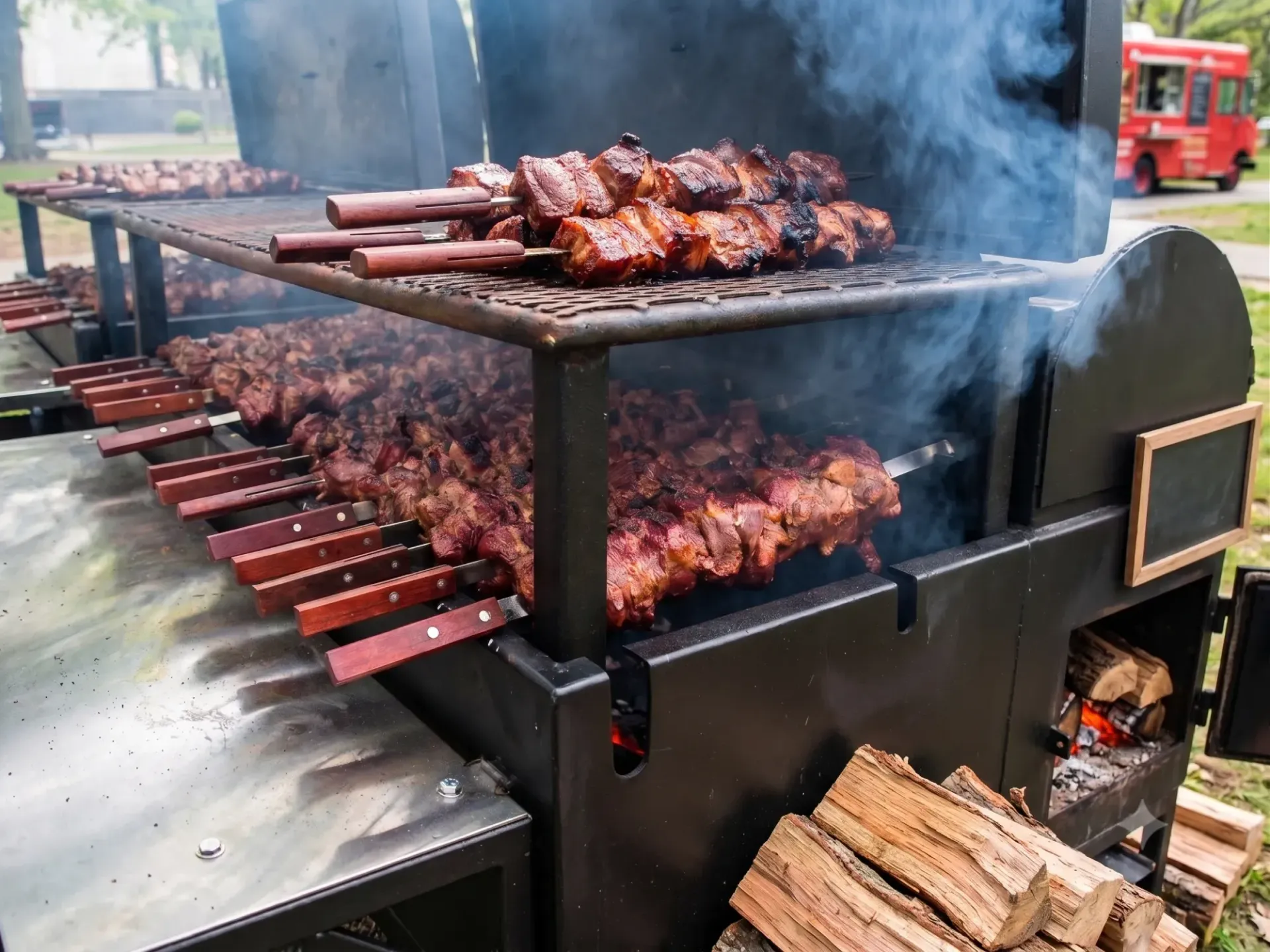
Long-smoke items like brisket and pork shoulder are smoked overnight in our commercial smokers at the farm, where temperature and smoke can be held steady hour after hour. Our 14-hour slow smoked beef brisket is the flagship of this process. On the day of your event, the meats travel with our crew to your venue, where they are finished on-site over authentic charcoal pits with live wood and fire, alongside rotisseries and Brazilian-style skewers for items cooked from raw. The overnight smoke gives us the consistency a 500-person wedding demands. The on-site finish gives your guests everything people love about real BBQ: the fire, the aroma, and meat that tastes like it just came off the pit, because it did!
The Live Fire Experience
Numbers and processes matter, but they are not what guests remember. What guests remember is walking into an event and smelling hardwood charcoal in the air before they even see the food. The glow of live coals in the pits. Rotisseries turning slowly over open fire. Brazilian-style skewers coming off the flames. The sound and sizzle of meat being finished a few feet away from where they are standing.
This is the part of Southern BBQ that no indoor kitchen can replicate, and it is the heart of what we bring to an event. Our cooking stations are set up in view of guests wherever the venue allows, because the cooking is part of the entertainment. People gather at the pits, watch the carving, ask the crew questions, and take photos. A BBQ Feast event does not just serve dinner. It gives your guests something to gather around, which is what barbecue has been about since the beginning.
The Anatomy of Quality BBQ: Smoke Ring, Bark, and Flavour
Hardwood Charcoal and Clean Combustion
Our on-site finishing pits burn pure lump hardwood charcoal, and the choice matters more than most people realize. Commercial briquettes contain binders and fillers that can release chemical off-notes into food during cooking. Lump hardwood charcoal is just carbonized wood with no additive.
A properly managed lump fire burns clean, producing the light, almost invisible smoke that pitmasters prize. That clean smoke is what gives BBQ its aromatic depth without bitterness. A dirty, smoldering fire produces heavy white smoke that ruins food. Keeping the fire clean is a skill our crew has honed over decades, and it is one of the key differentiators for BBQ to taste authentic.
The Rub and the Bark
The dark, mahogany crust on a properly cooked brisket or rib is called the bark, and it is where much of the flavour lives. It forms slowly over the long cook as the rub and the surface of the meat transform in the heat and smoke. Beneath it sits the pink smoke ring, the visual signature of meat that spent real hours over real wood smoke.
BBQ Feast’s proprietary house rub was developed over decades of cooking, and it is built to do two jobs at once: season the meat deeply, and form that dark, crunchy bark guests remember. What that means on the plate is simple: better flavour, better texture, juicier meat, and authentic BBQ that does not need to hide under heavy sauce.
Operational Review: Pit Dynamics and Event Workflows
Running a full BBQ menu for a large event is a scheduling puzzle. Different proteins take dramatically different amounts of time, and everything has to converge on the same service window.
For a Saturday event, brisket typically goes on the smoker Friday afternoon for its 14-hour-plus cook. Bone-in pork shoulders follow for an 8 to 9 hour overnight smoke. Ribs run their own shorter cycle. Chicken, sausages, Brazilian-style picanha skewers, and other from-raw items are cooked fresh on-site over charcoal, timed to come off the fire minutes before guests are served.
Then comes the drive. Moving a full catering operation along the QEW or the Don Valley Parkway into downtown Toronto, Mississauga, or Vaughan during the event season is its own logistical discipline. Transporting smoked meats is a science of its own: wrapped wrong, hours of carefully built bark can steam into mush before arrival. Industry best practice favours breathable wrapping over sealed foil precisely for this reason, letting excess moisture escape while the juices stay in the meat, so the bark arrives crisp and the interior arrives juicy. It is one of many small details that decide what your guests actually see and taste.
Serving Toronto and the GTA at Any Scale
BBQ Feast operates from our 100-acre farm in Lakeside, Ontario, with mobile catering rigs that deploy across Southern Ontario and the entire GTA corridor: downtown Toronto, Mississauga, Vaughan, Markham, Brampton, and beyond. Since 1998 we have catered thousands of events, from intimate family gatherings to weddings, festivals, community celebrations, and corporate BBQs serving thousands of guests. During peak season our crews run up to five events on a single weekday and four weddings on a Saturday.
That range is possible because we own and transport virtually everything an event requires. Commercial smokers and on-site charcoal pits. Rotisseries for chickens and picanha, including a specialized corn rotisserie that roasts 250 to 300 cobs at a time in their natural husks, steaming the kernels from the inside out (it handles 500 baker-size potatoes just as easily). Power generators, commercial refrigeration, heavy-duty tenting, buffet tables, linens, and serving equipment. Independent handwashing stations and integrated water systems complete the setup.
For property managers and event planners, that last item is often the deciding factor. Because our rigs are fully self-contained, we can cater in concrete downtown courtyards, rooftop terraces, remote parks, and venues with no water or power hookups, with zero reliance on your building’s utilities or kitchen space. We recently ran a large corporate BBQ in downtown Toronto on exactly this model: a full live-fire setup, thousands of guests served across the day, and no demands on the venue beyond the footprint we set up on. It removes an entire category of planning risk, and it opens up venues that conventional caterers simply cannot service.
Frequently Asked Questions
How does true Southern BBQ style differ from standard grilled catering?
Standard grilled catering cooks proteins quickly over gas or in a commercial oven, then applies sauce to finish. True Southern BBQ smokes tough cuts like brisket, pork shoulder, and ribs at low temperatures for many hours over hardwood, then finishes them over live fire. The result has a visible smoke ring, a dark caramelized bark, and a depth of flavour and tenderness that grilled meat cannot replicate.
Is BBQ Feast fully self-sufficient for outdoor venues in downtown Toronto?
Yes. Our mobile rigs carry independent handwashing stations, water systems, generators for power, refrigeration, and tenting for weather. We can cater in downtown concrete plazas, corporate rooftops, and remote park venues without depending on venue hookups or municipal utilities.
How do smoked meats stay fresh during transport to the venue?
Moisture management is the key. Meats wrapped in sealed foil steam themselves during transport, which softens the bark that hours of smoking built. Industry best practice is breathable wrapping that lets excess vapour escape while keeping the juices in the meat, so it arrives with the bark intact and the interior juicy. Combined with insulated thermal holding at safe temperatures, the meat reaches your event tasting like it just came off the smoker.
Can your mobile rigs accommodate venues with strict fire and open-flame codes?
Yes, though the specifics depend on the venue. Because our long-smoke items are cooked at our facility overnight and finished on-site, we have flexibility that full on-site pit setups do not. We work with venue teams and coordinate with fire marshals on codes and permits when required.
What is the timeline requirement for sourcing and prepping a Whole Pig Roast?
Whole pig roasts require additional lead time for sourcing and preparation. We recommend booking whole pig events at least 4 to 6 weeks in advance for smaller gatherings, and 3 to 6 months ahead for weddings and major corporate functions.